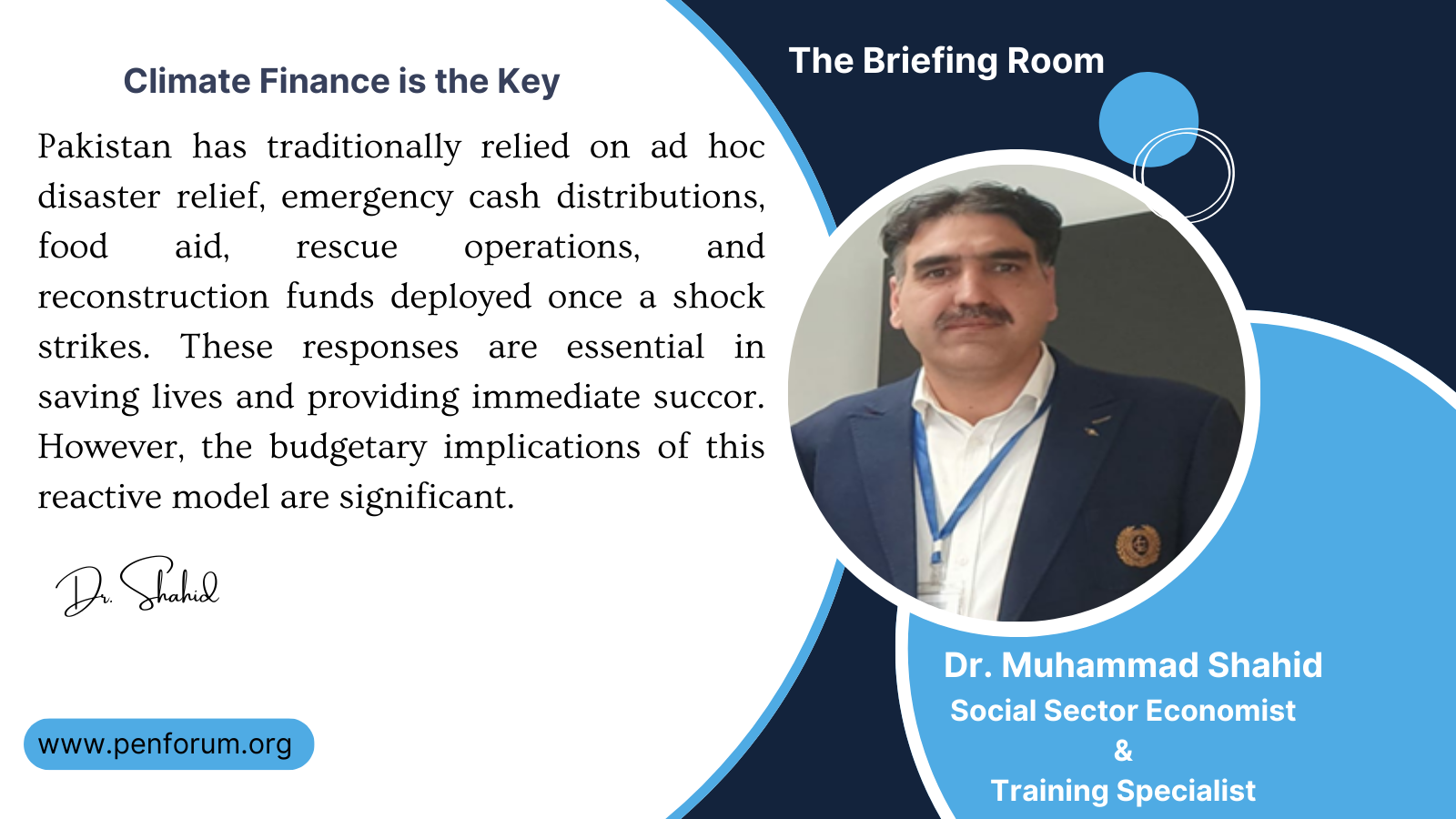
Dr. Muhammad Shahid & Rehan Khalid
| When floodwaters surged across Pakistan in 2025, they did not just swallow homes and fields but they drowned economic hopes, livelihoods, and the nation’s growth story. Climate change, once a distant alarm, has become an everyday crisis. Its cost is now written not only in broken lives but also in grim numbers flashing across economic forecasts. The State Bank of Pakistan has already cut its growth outlook for FY26, slashing GDP projections to the lower end of its 3.25 percent to 4.25 percent range. But private-sector watchers are less optimistic and warns growth could plunge to just 2.75 percent to 3.25 percent, citing agricultural collapse and cascading macroeconomic pressures. The country’s economic pulse, battered by rising waters, is beating weak and uneven. Agriculture: The First Casualty Pakistan’s lifeline, agriculture, was struck hardest. Initial estimates place flood losses at Rs. 302 billion, nearly a quarter of a percentage point of GDP. Cotton and rice, the key export earners were devastated, with projected damages of 10% and 15%, respectively. Wheat and flour prices skyrocketed by 38–40%, while vegetables spiked around 40% within weeks. The government has declared an agriculture emergency, scrambling to provide electricity waivers for farmers, but for millions of rural families, recovery looks distant. When fields drown, jobs vanish, and food security crumbles. Beyond fields, Pakistan’s roads, bridges, and communications infrastructure took a pounding, with damages worth Rs. 97.6 billion. Housing losses are estimated at Rs. 8.95 billion, leaving thousands displaced. Though livestock losses were minor, the ripple effect is massive. Without transport and storage, even surviving crops rot before reaching markets. For ordinary citizens, the floods mean longer queues, higher prices, and shrinking incomes. For the unemployed, especially young people, the disaster deepens despair. With over 60% of Pakistan’s population under 30, a battered economy risks pushing a restless generation further to the margins. Floods triggered an inflationary spiral. September food inflation alone surged 8–9% month-on-month. For FY26, inflation is now projected at 6.5%–7.5%, up from the earlier 6%–7%. Households that had barely adjusted to last year’s inflation shock now face another round of belt-tightening, this time driven by climate chaos rather than fiscal mismanagement alone. The deluge is not just a humanitarian crisis but a fiscal one also. Pakistan’s fiscal deficit is now revised to 4.8 percent of GDP, up from 4.1 percent of GDP, with revenues expected to shrink to Rs. 13.6 trillion instead of Rs. 14.1 trillion. The government’s primary balance, once a rare bright spot, will slip to 1.6 percent of GDP. Externally, the picture is equally precarious. Pakistan’s financing requirement stands at 10.5 billion dollars to 11.5 billion dollars, even as foreign reserves are expected to hover just above $17 billion by June 2026. The rupee, battered by repeated shocks, is forecast to slide further, settling between Rs292–297 per dollar. The timing could not be worse. The International Monetary Fund (IMF) is set to conduct its semi-annual review of Pakistan’s $7 billion Extended Fund Facility on September 25, 2025. With flood damages pegged at Rs. 409 billion ($1.4 billion, or 0.33% of GDP). Observers warn that without climate-aligned economic planning, Pakistan risks lurching from one bailout to the next. The floods aren’t just a natural disaster but they’re an economic reset. Unless resilience is built into policy, every monsoon season could shave off another point from GDP. The human toll of these economic tremors is most visible in rising youth unemployment. Already struggling with limited opportunities, young Pakistanis now face a shrinking job market as agriculture contracts and manufacturing slows. The fear is not only joblessness but the social unrest that could follow. For a nation where youth represent both its largest challenge and potential, climate-driven economic shocks risk wasting an entire generation. The “youth bulge” that policymakers once framed as a demographic dividend increasingly looks like a ticking time bomb. Climate Change: The Elephant in the Room What makes Pakistan’s crisis unique is its low contribution to global emissions yet high vulnerability to climate shocks. With each new flood, storm, or heatwave, Pakistan pays billions for a problem it barely created. The damage goes beyond crops and GDP. it’s about lost schooling days, health crises, and widening poverty gaps. Experts argue that climate finance must be central to Pakistan’s economic survival strategy. Domestic reforms, though necessary, cannot plug the massive financing gap left by repeated climate disasters. International support, tied to climate resilience, is the need of the hour. Where Do We Go From Here? The government is scrambling with stop-gap measures including electricity waivers, relief packages, and appeals to donors. But the larger challenge is systemic, that is mainstreaming climate resilience into economic planning. Agriculture must be climate-proofed with better irrigation, crop diversification, and disaster insurance. Infrastructure must be built to withstand extreme weather. Youth must be equipped with skills to shift into climate-smart sectors such as renewable energy, IT, and resilient supply chains. Without such forward-looking steps, Pakistan will remain trapped in a vicious cycle of disaster, bailout, recovery, repeat. The Bottom Line The 2025 floods are more than a seasonal misfortune. They are a stark reminder that climate change is Pakistan’s harshest economic reality. With GDP growth slashed, inflation soaring, and millions facing uncertainty, the message is clear, that is, the cost of inaction is no longer abstract. It’s measured in billions lost, jobs destroyed, and futures dimmed. For Pakistan, the rising waters are not just about climate. They’re about survival. |