Dr. Muhammad Shahid & Rehan Khalid
In a groundbreaking step towards data-driven governance, Pakistan has unveiled the results of its first-ever integrated Economic Census, conducted alongside the 7th Population and Housing Census 2023. The report, released by the Pakistan Bureau of Statistics (PBS), offers the most comprehensive snapshot to date of the country’s economic landscape—capturing the scale, diversity, and challenges of businesses across Pakistan.
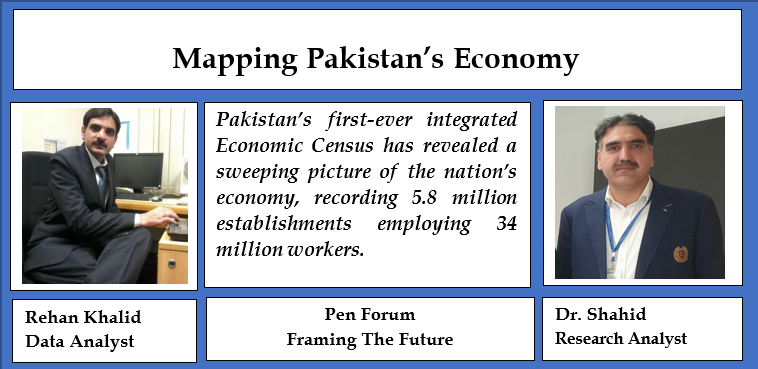
For the first time in the nation’s history, economic data was collected in tandem with demographic data, enabling planners to link population trends with enterprise activity. The findings are monumental: 5.8 million economic establishments were recorded across Pakistan, employing an estimated 34 million workers. This rich database not only highlights the scope of Pakistan’s economic footprint but also provides an invaluable foundation for future policymaking, investment, and growth strategies.
The Rise of Household Enterprises
One of the most striking insights from the report is the prevalence of small-scale, household-based economic activities. An estimated 65% of establishments operate from homes, underscoring the importance of micro-enterprises in sustaining family incomes. These range from tailoring and embroidery workshops to small-scale food production, tuition centers, poultry farming, and digital freelancing. Such activities—often run by women and youth—highlight the resilience of Pakistan’s informal economy, even though much of it remains outside the formal tax net.
| 5.8 Million Establishments, 34 Million Workers Uncovered in Landmark Census |
Workforce Composition: Gender Gaps Persist
The census places the national workforce at over 34 million, with men comprising roughly 73% of workers and women accounting for 27%. While the growing role of women in cottage industries, services, and freelancing is evident, the data points to persistent gender disparities that limit female participation in larger-scale, formal enterprises. Analysts believe these gaps must be addressed through targeted skills training, childcare support, and inclusive workplace policies.
Sectoral Spread
Trade, manufacturing, and services dominate Pakistan’s economic map. Retail shops, workshops, and service providers account for the majority of establishments, while factories and large enterprises make up a smaller but vital share. The census also geo-tagged nearly 40 million structures nationwide, enabling policymakers to identify clusters of economic activity and underserved regions in need of investment.
Challenges and the Way Forward
Despite its scale, the census acknowledges gaps—particularly in capturing mobile, temporary, and informal economic activities such as street vending and pop-up markets. Moreover, the fast-expanding digital economy remains underrepresented. To strengthen accuracy, PBS employed advanced technologies including machine learning and natural language processing to clean and validate data, but it recommends regular updates and broader coverage in future exercises.
A Foundation for Inclusive Growth
The Economic Census marks a transformative shift for Pakistan. By providing a reliable business register, it enables the government to design evidence-based policies, poverty reduction strategies, and investment roadmaps. More importantly, it shines a light on the millions of small enterprises and informal businesses that have long powered the country’s economy but remained invisible in official statistics.
As Pakistan navigates economic headwinds, this unprecedented mapping of its entrepreneurial backbone may well serve as the compass for inclusive and sustainable growth in the years ahead.