
Dr. Muhammad Shahid & Rehan Khalid
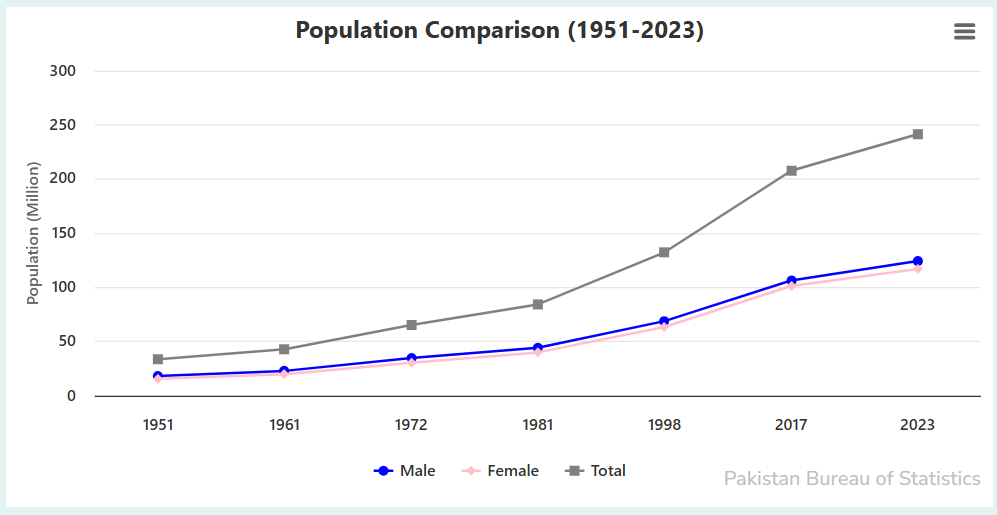
| The population trajectory of Pakistan, as illustrated by the census comparison from 1951 to 2023, tells a powerful story of relentless growth and mounting pressure. From a modest population of around 34 million in 1951, Pakistan has expanded to nearly 242 million by 2023—an almost sevenfold increase in just over seven decades. Both male and female populations have grown steadily, closely mirroring each other, while the total population curve steepens sharply after the 1980s. This demographic surge reflects sustained high fertility rates, declining mortality due to medical advances, and limited success in population management policies. While this growth has expanded the labor force and domestic market, it has also pushed the country to the edge of a demographic tipping point. The causes of rapid population growth in Pakistan are deeply structural. Persistently high fertility rates, early marriages, low female labor force participation, limited access to family planning services, and gaps in female education continue to drive population momentum. Cultural norms favoring larger families, coupled with uneven implementation of reproductive health programs, have further constrained demographic transition. Meanwhile, improvements in child survival and life expectancy, though positive achievements have accelerated population expansion in the absence of commensurate fertility decline. |
| The challenges arising from this population explosion are profound and multidimensional. Rapid growth has placed immense strain on public services, including education, health, housing, water, and sanitation. Job creation has failed to keep pace with the expanding working-age population, contributing to unemployment, informality, and poverty. Urban centers are swelling uncontrollably, resulting in congestion, slums, and environmental degradation. At the macroeconomic level, population pressure dilutes per capita income gains, undermines savings and investment, and complicates efforts to achieve sustainable and inclusive growth. Without decisive action, Pakistan risks turning its potential demographic dividend into a demographic liability. An effective policy response requires a decisive shift from rhetorical commitment to coordinated action. Population management must be treated as a core economic and development priority rather than a peripheral social issue. This includes universal access to quality family planning services, large-scale investment in girls’ education, delayed age of marriage, and the economic empowerment of women. Integrating population planning with health, education, climate, and employment policies is essential. Equally important is strengthening data-driven governance, using census and registry data to guide targeted interventions. Pakistan’s population curve is still rising—but with timely, evidence-based, and politically backed policies, the country can bend this curve toward sustainability, resilience, and shared prosperity. |


