Executive Summary
Pakistan has made moderate strides in narrowing gender disparities across multiple dimensions of human development. The country’s Gender Development Index (GDI) currently stands at 0.838, reflecting a steady yet slow progression from 0.541 in 1990. However, this improvement has not translated into parity, as deep-rooted structural and cultural barriers continue to constrain women’s full participation in society. The stagnation of Pakistan’s Gender Inequality Index (GII) at 0.54 since 2020 exemplifies the limits of existing frameworks. This policy paper synthesizes key trends in gender development and provides a strategic agenda to bridge the persistent gender divide by accelerating progress toward equity.
Keywords: Gender Development, GDI, GII, Gender Equality, Inclusive Growth, Pakistan, Human Development, Policy Reform
Context and Problem Statement: Pakistan’s gender development trajectory reveals a paradox: significant gains in some indicators coexist with stagnant or lagging performance in others. While female life expectancy, education attainment, and GNI per capita have improved, challenges in health access, economic inclusion, and political participation persist. Despite the increase in female representation in parliament and implementation of gender-responsive budgeting, Pakistan remains far from achieving gender parity.
Key Trends in Gender Development
- Gender Development Index: The latest Human Development Report released by UNDP reveals a moderate yet gradual upward trajectory in Pakistan’s Gender Development Index (GDI), now standing at 0.838. This metric reflects the comparative achievements of women and men in key dimensions of human development, including health, education, and command over economic resources. While the current GDI suggests an improvement in gender parity relative to earlier decades, the persistent gender gap underscores systemic barriers impeding equitable access to development opportunities. The prevailing GDI score positions Pakistan within the medium human development category, indicating that despite policy shifts and gender-focused interventions, structural inequalities continue to inhibit optimal female participation in socioeconomic domains.
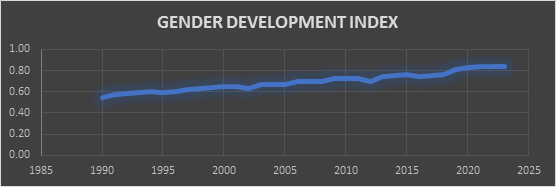
A longitudinal analysis of Pakistan’s GDI trajectory illustrates incremental progress, rising from 0.541 in 1990, to 0.651 in 2000, and 0.726 in 2010, culminating in the present 0.838. This decade-wise improvement is indicative of a steady evolution in gender-sensitive policy formulation and implementation. However, the pace of change remains suboptimal when benchmarked against regional and global averages, revealing a pressing need for more transformative, intersectional gender strategies. Moving forward, closing the gender development gap will require not just investment in female-centric human capital but also the dismantling of sociocultural norms and institutional biases that perpetuate gender disparities in Pakistan.
- 2. Gender Inequality Index: The Gender Inequality Index (GII) for Pakistan, as reported in the latest UNDP Human Development Report, stands at 0.54, reflecting a complex interplay of persistent structural inequities and partial gains in women’s empowerment and reproductive health. While this figure marks a significant reduction from the GII of 0.80 in 1990, it also signals a troubling stagnation, as the index has remained unchanged since 2020. This plateau highlights the limitations of current gender-responsive frameworks and the need for recalibrated, multi-sectoral interventions. Despite visible improvements over decades—driven by both political will and international development commitments—the lack of progress in recent years suggests that policy impact is not translating effectively into measurable outcomes at scale.

A decade-wise trajectory reveals a marked decline in gender inequality during the 2000s, most notably under a military-led regime, where the GII dropped from 0.77 in 2000 to 0.60 in 2010. This phase, though politically controversial, was characterized by the rollout of gender-targeted reforms, enhanced female access to education, and entry-level economic participation. However, the current impasse in gender inequality metrics demands a paradigm shift—from ad hoc initiatives to institutionalized, gender-transformative policies that embed equity into the very architecture of governance, labor markets, health systems, and civic participation.
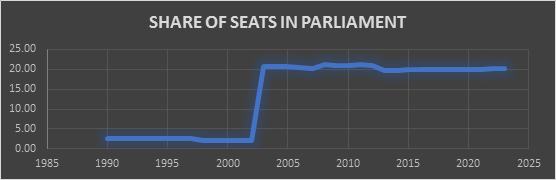
- 3. Share of women in parliament: The latest Human Development Report by UNDP highlights a pivotal advancement in Pakistan’s gender governance landscape. The share of women in parliamentary seats has risen from a marginal 2.63% in 1990 to a more substantive 20.14% in 2022. This upward trend in women’s political representation signifies a critical structural shift toward inclusive policymaking and democratic deepening. Enhanced presence of women in legislative forums is not merely symbolic—it has the potential to reshape policy priorities, ensure gender-sensitive lawmaking, and institutionalize women’s voices in national discourse. This progress aligns with global best practices and underscores Pakistan’s commitment to the Beijing Platform for Action and SDG 5, which emphasize political participation as a lever for broader gender equality.
Complementing this trajectory is the progressive adoption of gender-responsive budgeting (GRB), a strategic fiscal tool that integrates gender analysis into public expenditure and resource allocation processes. By embedding equity considerations into the budget cycle, GRB helps address systemic disparities and ensures that development financing is inclusive, targeted, and impact-oriented. Together, increased parliamentary representation and gender budgeting represent a synergistic policy shift—one that not only enhances accountability and transparency but also fosters an enabling environment for transformative gender justice in Pakistan’s socio-political fabric.
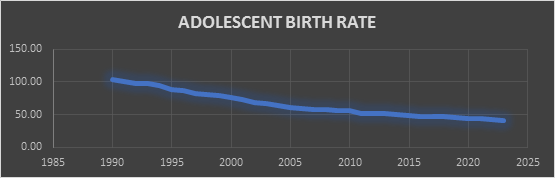
- 4. Adolescent Birth Rate (ABR): According to the latest Human Development Report released by UNDP, Pakistan has witnessed a significant reduction in the Adolescent Birth Rate (ABR)—from 104.43 births per 1,000 women aged 15–19 in 1990 to 41.10 in 2023. This decline marks a critical improvement in women’s reproductive health and reflects the positive outcomes of targeted health sector reforms, increased access to family planning services, and expanded adolescent health awareness. The downward trend in ABR not only contributes to improved maternal health outcomes but also aligns with global efforts under SDG 3 (Good Health and Well-being) and SDG 5 (Gender Equality), signaling progress in curbing early pregnancies, which are often linked to educational dropout, economic vulnerability, and intergenerational cycles of poverty.
This encouraging shift underscores the growing impact of rights-based health programming, community-level interventions, and the integration of reproductive health education into national development agendas. It also reflects a changing societal narrative where young women are increasingly empowered to exercise agency over their reproductive choices. However, to sustain and accelerate this momentum, it is imperative to institutionalize comprehensive adolescent health policies, expand access to age-appropriate sexual and reproductive health services, and address socio-cultural determinants that perpetuate early childbearing. The reduction in ABR is not only a public health milestone but also a strategic investment in human capital development and gender equity.
- 5. Maternal Mortality Rate: The latest Human Development Report by UNDP underscores a noteworthy advancement in Pakistan’s maternal health landscape, with the Maternal Mortality Rate (MMR) declining from 356.23 per 100,000 live births in 1990 to 154.16 in 2023. This substantial reduction reflects cumulative gains from enhanced investments in primary healthcare infrastructure, skilled birth attendance, antenatal care coverage, and community-based maternal health interventions. The trajectory suggests progress toward achieving SDG 3.1, which calls for reducing global maternal mortality to less than 70 per 100,000 live births. Moreover, it signals that targeted public health strategies and donor-supported maternal health programs are delivering measurable outcomes across key performance indicators.
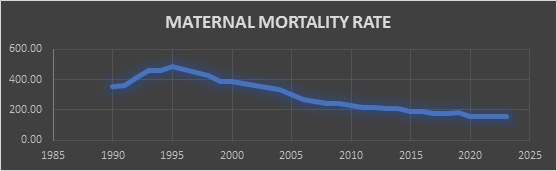
However, despite this commendable progress, the current MMR remains unacceptably high by global benchmarks, revealing persistent disparities in access, quality, and continuity of care—particularly in underserved rural and peri-urban areas. Structural gaps such as unequal distribution of trained health professionals, fragile referral systems, inadequate emergency obstetric care, and limited reproductive health literacy continue to compromise maternal outcomes. To close this gap, there is an urgent need to implement resilient, equity-driven health system reforms, bolster midwifery and obstetric training, and integrate maternal health into broader social protection frameworks. The path to further reducing MMR lies in institutionalizing a whole-of-government approach that ensures no woman dies giving life due to preventable causes.
- 6. Gross National Income (GNI) per capita (Female): The latest UNDP Human Development Report reveals a substantial rise in Gross National Income (GNI) per capita for females in Pakistan, which has increased from USD 557.53 in 1990 to USD 2,173.23 in 2023. This upward trajectory signals incremental economic empowerment and a gradual integration of women into the formal and informal economic landscape. It reflects the cumulative effects of expanded access to education, targeted livelihood programs, increased female participation in micro-enterprises, and gender-focused financial inclusion strategies. The rise in female GNI per capita is a positive indicator within the broader Human Development framework, suggesting a narrowing gender income gap and progress toward inclusive economic growth.

However, while the trend is promising, the figures still underscore a persistent gender earnings disparity, especially when compared to male GNI and regional averages. Structural barriers—including occupational segregation, wage discrimination, limited asset ownership, and care-related constraints—continue to inhibit the full economic potential of women in Pakistan. To unlock inclusive productivity and harness the demographic dividend, it is essential to institutionalize gender-intentional economic policies, invest in skill development aligned with market demand, and ensure enabling environments for women entrepreneurs. The enhancement of female GNI is not just an economic metric—it is a strategic lever for socioeconomic transformation and sustainable human development
- 7. Mean years of schooling: According to the latest Human Development Report by UNDP, mean years of schooling for females in Pakistan has surged from a modest 1.03 years in 1990 to 3.97 years in 2023, marking a significant, albeit gradual, shift in the educational attainment landscape. This improvement reflects the cumulative impact of pro-poor education policies, targeted girls’ enrollment drives, school infrastructure expansion, and conditional cash transfer programs such as those under BISP. The upward trend also underscores the growing recognition of female education as a critical driver of human capital formation, intergenerational mobility, and inclusive socioeconomic progress.
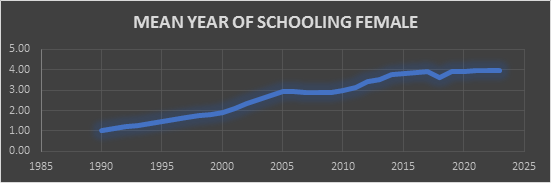
Despite this encouraging trajectory, the data reveals that female educational attainment still lags considerably behind global and regional averages, signaling a deep-rooted gendered divide in access, retention, and quality of education. Structural challenges such as poverty, early marriage, socio-cultural constraints, and insufficient gender-sensitive schooling facilities continue to limit progress. To further accelerate gains, it is imperative to adopt a whole-system, equity-based approach to education reform—strengthening governance, enhancing teacher quality, ensuring safe learning environments, and aligning curricula with 21st-century skills. Elevating the mean years of schooling for girls is not merely a statistical target, but a strategic imperative for achieving gender equality, economic resilience, and sustainable human development in Pakistan.
- 8. Expected Years of Schooling: The latest Human Development Report by UNDP reveals a noteworthy advancement in Pakistan’s educational outlook for women, with Expected Years of Schooling for females rising from 2.75 years in 1990 to 7.31 years in 2023. This upward shift reflects progressive strides in universal primary education policies, gender-focused enrollment initiatives, and infrastructure investments in underserved regions. The increase is emblematic of a national commitment to human capital development and aligns with global frameworks such as SDG 4 (Quality Education) and SDG 5 (Gender Equality). It also indicates a growing societal recognition of education as a transformative lever for female empowerment and long-term economic inclusion.

However, while this trajectory signals progress, the current figure remains below global averages, exposing persistent gaps in access, equity, and quality across the education value chain. Key constraints—including gender-based dropout rates, limited post-primary opportunities, cultural barriers, and security-related concerns—continue to impede sustained gains. To fully harness the demographic potential of Pakistan’s female population, it is imperative to adopt a holistic, life-cycle approach to education policy, encompassing early childhood development, adolescent learning, and pathways to tertiary education. Prioritizing girls’ learning outcomes and retention will not only elevate expected years of schooling but also catalyze broader social mobility, labor market participation, and intergenerational equity.
- 9. Life expectancy at birth: The latest Human Development Report by UNDP highlights a significant improvement in female life expectancy at birth in Pakistan, which has increased from 60.84 years in 1990 to 70.16 years in 2023. This decade-on-decade progress is indicative of enhanced public health infrastructure, improved maternal and child health services, greater access to immunization and primary care, and advancements in disease prevention and nutrition. The upward trend also reflects the positive spillover effects of socio-economic interventions, such as gender-responsive health policies, expanded outreach of Lady Health Workers, and greater awareness of women’s health rights. This longevity gain signals a transition toward better health outcomes and resilience for women across the life course.

Despite these advancements, persistent structural inequities in healthcare delivery—especially in rural and marginalized communities—continue to constrain further improvements. High fertility rates, gender-based health disparities, and limited access to quality reproductive and geriatric care remain critical barriers. To consolidate and accelerate gains in female life expectancy, Pakistan must institutionalize universal health coverage with a gender equity lens, scale integrated service delivery models, and invest in preventive, promotive, and curative health systems tailored to women’s life-stage needs. Increasing female life expectancy is not only a marker of human development—it is a strategic enabler for achieving sustainable, inclusive, and equitable national growth.
- Human Development Index for females: The latest Human Development Report by UNDP underscores a steady, albeit insufficient, advancement in gender-specific development outcomes in Pakistan. The Human Development Index (HDI) for females has risen from a low baseline of 0.257 in 1990 to 0.485 in 2023, reflecting incremental progress in education, health, and income dimensions for women. This positive trajectory is a testament to decades of targeted interventions including expanded access to girls’ education, maternal health initiatives, and economic empowerment programs. However, the figure remains significantly below the national average and global benchmarks, highlighting that Pakistan has yet to fully capitalize on the developmental dividends of its female population, which constitutes nearly half of the country’s demographic fabric.

Despite evident gains, the persistently low female HDI calls attention to deep-rooted structural and institutional disparities that continue to marginalize women from equitable access to resources and opportunities. The path forward demands a systematic integration of gender-sensitive policy frameworks across all tiers of governance—policies that not only correct historic imbalances but also proactively embed equity into fiscal planning, service delivery, and institutional accountability. Without a transformative shift toward gender-responsive development planning, Pakistan risks constraining its overall human development potential. Accelerating female HDI must be treated as both a rights-based imperative and a strategic lever for achieving inclusive, sustainable, and resilient national development.
Conclusion: The rise of Pakistan’s Gender Development Index to 0.838 is a testament to progress, but the road to parity remains long. Transforming gender development from numbers to narratives requires a whole-of-government and whole-of-society approach. Investing in women is not only a rights-based imperative but also a pathway to unlocking Pakistan’s full human potential. A recalibrated, inclusive, and institutionalized gender policy agenda will be critical to ensuring that future generations inherit an equitable and empowered Pakistan.
References:
Breaking the Gridlock, UNDP Report,
Contact for further information:
Lead Author: Dr. Muhammad Shahid (Team Lead at PEN Forum) & can be reached dr.shahid@penforum.org Co-Author: Rehan Khalid (Data Analyst at PEN Forum) & can be reached rehan@penforum.org