
Dr. Muhammad Shahid & Rehan Khalid
Pakistan’s newly released economic census paints a vivid picture of its commercial backbone. Wholesale and retail trade dominates with 2.9 million establishments, trailed by manufacturing (nearly 700,000), education (327,000) and health and social work (124,000). The figures highlight both the breadth and fragmentation of economic activity, with much of the country’s dynamism resting on small-scale enterprises.
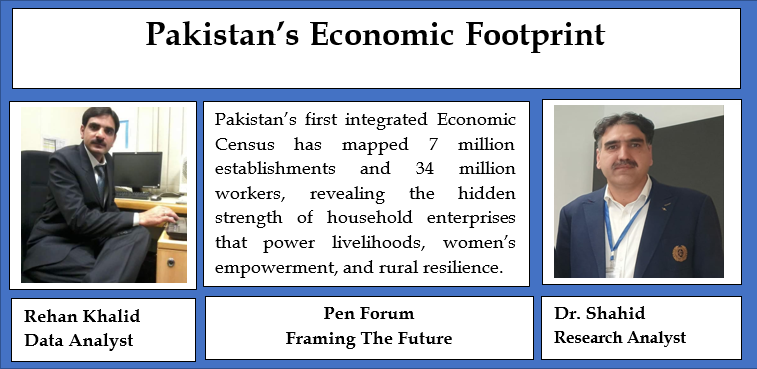
| Pakistan’s first integrated Economic Census has mapped 7 million establishments and 34 million workers, revealing the hidden strength of household enterprises that power livelihoods, women’s empowerment, and rural resilience. By combining cutting-edge digital tools with the 7th Population Census, the initiative delivers a Rs7bn saving and a historic Statistical Business Register, giving policymakers a data-rich compass for inclusive growth and economic transformation. |
The informal economy remains a defining force. Around 10.9 million household-based units sustain livelihoods beyond the reach of formal regulation, from 5.6 million animal-farming operations to tailoring, embroidery, carpet weaving, poultry sheds and tuition centres. Though modest in scale, these ventures underpin rural incomes, provide a buffer against economic shocks and, crucially, broaden opportunities for women in the workforce. They are a reminder that Pakistan’s growth story lies as much in its backstreets and courtyards as in its factories and offices.
Pakistan’s Bureau of Statistics has wrapped up the 2023 Economic Census, folded seamlessly into the country’s first digital population and housing count. The joint exercise not only saved the exchequer an estimated Rs. 7 billion but also avoided duplication, creating a single, consolidated baseline for future socio-economic planning. More than a statistical achievement, the integration signals a shift towards leaner, technology-driven governance.
Pakistan’s latest census has mapped 7 million business establishments, spanning 99 industrial sectors under the Pakistan Standard Industrial Classification. The exercise is the bedrock of the country’s first Statistical Business Register (SBR), a tool designed to give policymakers the clarity needed for precision interventions in enterprise growth, labour markets, and the fast-evolving digital economy. The data reveal that nearly three in ten households (28.5%) run home-based economic activities, underscoring the informal sector’s hidden muscle in driving entrepreneurship, sustaining rural livelihoods, and opening doors for women’s economic participation. From tailoring shops to livestock rearing, these modest ventures remain the quiet engines of Pakistan’s employment landscape.


Beauty Fashion
wonderful points altogether, you just received a new reader. What would you suggest about your put up that you simply made some days ago? Any positive? http://www.ifashionstyles.com