
Dr. Muhammad Shahid & Rehan Khalid
| Weak institutions, bad governance, policy inconsistency, and slow economic growth have intertwined to pose one of the most critical challenges to Pakistan’s development trajectory. Despite being a country rich in human and natural resources, Pakistan has struggled for decades with governance deficits that undermine its economic potential and social progress. Institutional weaknesses in Pakistan manifest in the form of dysfunctional public sector bodies, politicization of key appointments, inadequate enforcement of laws, and deteriorating capacity within government agencies. According to recent assessments, Pakistan ranks poorly on global governance indicators, lagging significantly behind regional peers in government effectiveness and regulatory quality. The erosion of institutions such as the judiciary, parliament, and executive organs due to power struggles and vested interests has further exacerbated governance challenges. This institutional decay directly impacts the state’s ability to implement policies effectively and maintain investor confidence. Bad governance in Pakistan is reflected in endemic corruption, lack of transparency, weak rule of law, and political interference in administrative affairs. For instance, public institutions tasked with revenue collection, such as the Federal Board of Revenue (FBR), face constant failure in meeting revenue targets due to frequent political meddling and low morale stemming from sudden dismissals of senior officials. Policy inconsistency further compounds these problems. Pakistan’s economic policies have often swung unpredictably with changing governments, lacking continuity or long-term vision. Successive reform efforts, whether in tax administration or fiscal policy, have faced implementation hurdles due to shifting political priorities and institutional weaknesses. Such inconsistency discourages both domestic and foreign investment, as businesses struggle to navigate an uncertain policy landscape. Even ambitious projects like “Vision 2025” or economic stabilization initiatives have been hampered by slow execution and lack of coherence across government tiers. |
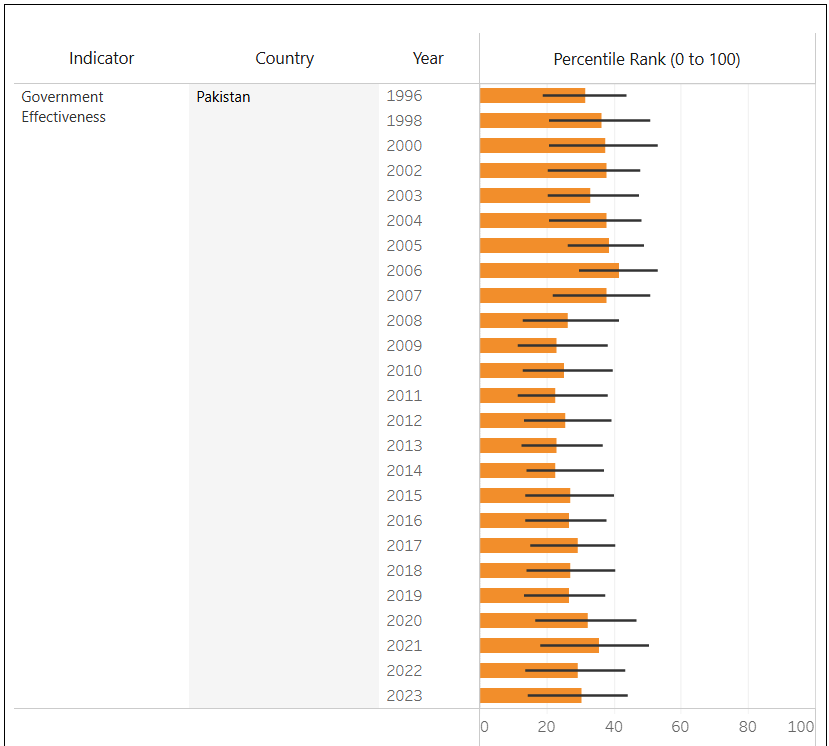
| These governance and institutional deficiencies translate into slow and fragile economic growth. Pakistan’s economy has experienced subpar expansion compared to regional counterparts, with sluggish GDP growth rate barely surpassing 3 percent. The heavy debt burden, which consumes a large share of government revenue, limits public investment in critical sectors such as education, health, and infrastructure. This spirals into weak productivity, low private investment rates, and limited job creation. Furthermore, rapid population growth without corresponding economic opportunity deepens poverty and heightens social instability, creating a negative feedback loop that risks further destabilizing governance structures. The persistent fiscal deficits and reliance on costly external borrowing exacerbate macroeconomic vulnerabilities, leaving Pakistan exposed to shocks and limiting fiscal space for development spending. The Bottom Line is: Without strengthening institutions, improving governance, ensuring policy consistency, and addressing structural economic issues, Pakistan risks remaining trapped in a cycle of stagnation and missed opportunities. Robust institutional reforms that enhance transparency, accountability, and capacity must accompany economic strategies to unlock Pakistan’s full development potential. Political leadership committed to stability, rule of law, and inclusive growth will be key to breaking the current impasse and fostering sustainable progress. |

