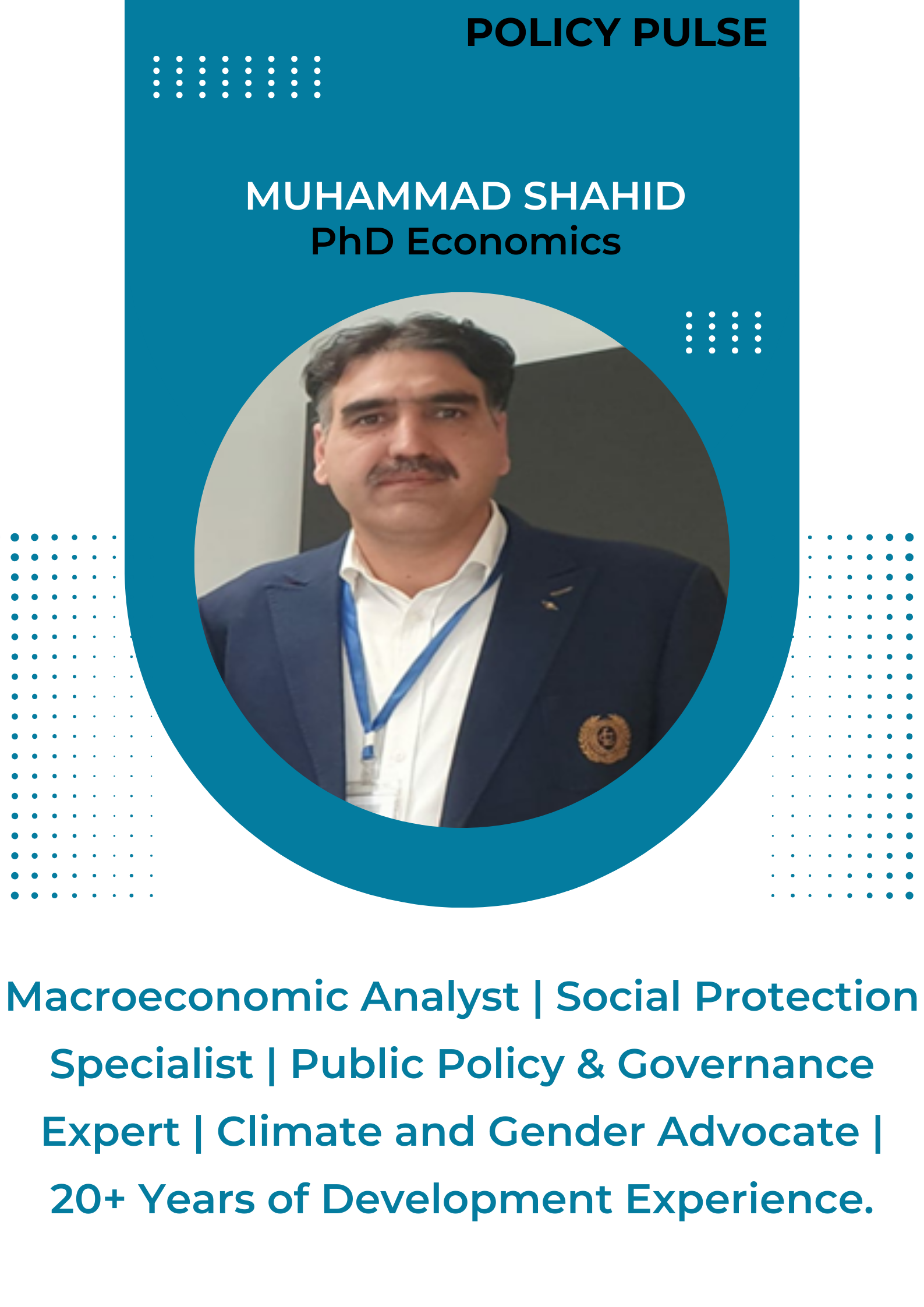
| DR. MUHAMMAD SHAHID |
| Pakistan’s economy, long synonymous with boom-and-bust cycles, is showing tentative signs of recovery. The Asian Development Bank (ADB), in its Asian Development Outlook released this week, projects that macroeconomic stability and policy reforms have lifted growth to a modest uptick in fiscal year 2025 (ending June 30). The report notes that Pakistan has managed to stabilize its battered economy, benefiting from investment flows, renewed business confidence, and structural reforms undertaken under the IMF’s Extended Fund Facility (EFF). Growth, however, remains fragile. The ADB forecasts GDP expansion of just 3% for FY2026, hardly the stuff of miracles, but a notable improvement from the near stagnation of recent years. The optimism is tempered with caveats where structural bottlenecks, climate shocks, and policy inconsistency continue to weigh heavily on the outlook. Pakistan’s economy, in short, has pulled back from the precipice, but remains far from safe ground. A Glimmer of Stability The ADB attributes much of Pakistan’s recent stabilization to “continued policy reforms and economic stability.” Following its October 2024 return to an IMF program, Islamabad has tightened fiscal management, rationalized subsidies, and allowed greater exchange rate flexibility. These measures have shored up foreign exchange reserves and tamed the volatility that had rattled markets in 2022–23. “Pakistan’s growth prospects remain positive,” said Emma Fan, ADB’s Country Director for Pakistan. “However, the country continues to face structural challenges, compounded by recurring disasters such as the recent floods. In this context, consistent reforms and policy implementation are essential for reinforcing policy credibility, sustaining economic momentum, and enhancing the country’s resilience.” The Fund’s medicine, bitter though it may be, appears to have instilled a measure of discipline. Improved external buffers, helped by a modest narrowing of the current account deficit and stronger remittance inflows, have bolstered business confidence. Meanwhile, the announcement of a US-Pakistan trade agreement has added a jolt of optimism, promising expanded market access and greater export diversification. Floods and Fiscal Firefighting Yet, nature has not been kind. The recent floods that inundated farmland and damaged infrastructure underscore the precariousness of Pakistan’s recovery. Agriculture, employing nearly 40% of the workforce, has been badly hit, while disrupted supply chains have triggered inflationary pressures. Average inflation is projected to rise to 6% in FY2026, within the central bank’s target range, but still painful for households already squeezed by higher gas tariffs and food shortages. The government has responded with fiscal incentives for the construction sector in its FY2026 budget, hoping to spur rebuilding and job creation. But such measures also risk colliding with IMF-mandated austerity, raising questions about policy coherence. The challenge for Islamabad is to pursue recovery without backsliding into old habits of fiscal indiscipline. The Politics of Reform Economic reform in Pakistan has always been as much political as technical. Subsidy rationalization, tax base expansion, and energy pricing reforms often provoke public anger and political pushback. The IMF program launched in October 2024 has demanded precisely these politically costly measures. The ADB’s report acknowledges this tension, urging “policy consistency” as vital to maintaining momentum. For Pakistan, consistency is a tall order. With provincial and national elections on the horizon, the temptation to soften reforms and dispense populist handouts remains strong. The test will be whether policymakers can resist electoral expediency in favor of fiscal prudence. Structural Fault-lines The medium-term picture remains clouded by structural weaknesses. Pakistan’s tax-to-GDP ratio hovers around 9%, among the lowest in Asia, starving the state of resources. Loss-making state-owned enterprises bleed billions annually. Energy sector circular debt continues to mount, even after repeated bailout packages. And despite the rhetoric of industrial policy, exports remain narrow and uncompetitive. The ADB report hints at these weaknesses, stressing the need to address “structural vulnerabilities” if growth is to become sustainable. Without deeper reforms in revenue mobilization, energy governance, and industrial diversification, Pakistan risks being trapped in the low-growth, high-debt cycle that has defined its economic history. The Climate Conundrum One of the starkest warnings in the ADB’s outlook is climate vulnerability. Pakistan has endured successive floods, droughts, and heatwaves in recent years, each exacting a heavy toll on agriculture, infrastructure, and livelihoods. The floods of 2022 pushed millions into poverty; the floods of 2025 remind policymakers that climate shocks are no longer rare disasters but recurring features of the economic landscape. Climate resilience, the ADB stresses, is not optional. Incorporating adaptation into fiscal planning, investing in resilient infrastructure, and leveraging green finance are critical. Yet Pakistan’s climate response remains fragmented, more reliant on donor-funded projects than coherent national strategy. The Resilience and Sustainability Facility under the IMF program offers an opening, but only if Islamabad can align climate financing with broader development planning. A Balancing Act for the Central Bank The State Bank of Pakistan faces its own tightrope walk. With inflation projected at 6% in FY2026, the temptation to loosen monetary policy and support growth will be strong. Yet premature easing could reignite inflationary pressures, particularly if supply disruptions persist. The ADB expects the central bank to adopt a “cautious approach,” keeping rates high enough to anchor expectations while gradually signaling an easing bias. This balancing act reflects the broader dilemma of Pakistan’s recovery: how to nurture growth without reigniting instability. Risks on the Horizon Despite the cautious optimism, the risks remain high. Political instability could derail reforms; and reversal of external conditions such as rising oil prices or tightening global liquidity could squeeze Pakistan’s fragile external account. Climate shocks, as recent experience shows, could wipe out gains overnight. Perhaps the greatest risk, however, lies in reform fatigue. After decades of IMF bailouts, Pakistan has often started strong but faltered midway, succumbing to vested interests and electoral calculations. If the current reform momentum stalls, the ADB’s projections of steady growth could prove yet another false dawn. The Road Ahead For now, Pakistan’s economy is showing signs of life. Growth has ticked upward, investment has revived, and macroeconomic conditions have stabilized. But this recovery is fragile, contingent on reforms that require political courage and policy discipline. Pakistan’s leaders face a stark choice. They can seize this moment to deepen reforms, broaden the tax base, invest in resilience, and reorient the economy toward productivity. Or they can relapse into short-term populism, squandering yet another opportunity and plunging back into crisis. The ADB report offers cautious optimism, but in Pakistan’s case, optimism has often been a scarce commodity. Whether this moment marks the start of a new trajectory or just another pause before the next crisis will depend not on donors, but on Pakistan’s own political will. Source: Asian Development Outlook |