Dr. Muhammad Shahid & Rehan Khalid
Good governance is the backbone of sustainable development, acting as the compass that guides nations toward prosperity and stability. When institutions are transparent, accountable, and effective, they not only foster economic growth but also invest in human capital and nurture social cohesion. Strong governance ensures that resources are managed wisely, policies are implemented fairly, and citizens have trust in the system which create a fertile ground for innovation and progress. The Worldwide Governance Indicators (WGI) capture these dynamics, offering a powerful lens to observe how perceptions of governance quality evolve across countries and over time, highlighting the undeniable link between governance and a nation’s long-term success.
Worldwide Governance Indicators (WGI), developed by the World Bank, provide a comprehensive snapshot of governance quality across six dimensions. These indicators measure perceptions of governance in nearly all countries, letting us assess strengths and weaknesses in Pakistan’s governance environment. The six WGI dimensions are
- Voice and Accountability
- Political Stability and Absence of Violence/Terrorism
- Government Effectiveness
- Regulatory Quality
- Rule of Law
- Control of Corruption
Source: Worldwide Governance Indicators (WGI) World Bank
Governance is more than a technical measure. It shapes how policies translate into real change, from lifting people out of poverty to building strong human capital and ensuring no one is left behind in deprivation or hunger. Strong governance can accelerate inclusive development, while weak governance risks trapping millions in cycles of hardship.
We will delve into the latest governance indicators for Pakistan, unpacking what they reveal about the nation’s path toward growth, development, and social progress. By examining these indicators, we uncover not only where Pakistan stands today, but also the critical reforms needed to create a future where prosperity is shared, opportunities are equal, and hunger and poverty become relics of the past.
1. Voice and Accountability This dimension reflects the extent of citizen participation in selecting their government, freedom of expression, association, and media. Pakistan scores relatively low on voice and accountability, reflecting significant challenges related to democratic freedoms and civic participation. Press freedom constraints and political instability have limited broader public engagement in governance. Despite improvements in media vibrancy, political influence on institutions and restrictions on dissent remain concerns.
Source: Worldwide Governance Indicators (WGI) World Bank
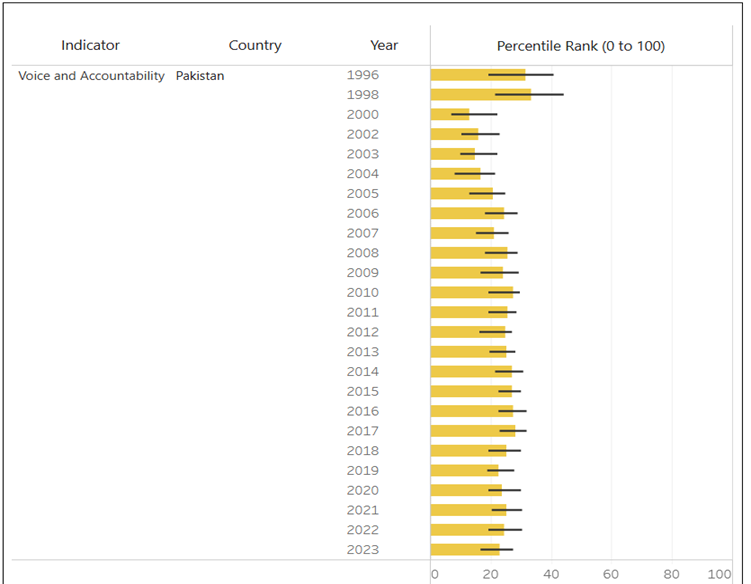
The above figure indicates that Pakistan’s Voice and Accountability percentile rank stood at 31.50 in 1996, offering a modest yet hopeful start toward democratic openness and citizen participation. By 1998, it inched up to 33.33, signaling some progress, but this momentum was short-lived. In 2000, the rank plummeted to a staggering low of 12.94, marking a severe setback in the country’s governance trajectory. Since then, Pakistan has struggled to regain ground, never crossing the 30-percentile mark again. The latest figure for 2023, at just 23.04, underscores a dismally poor performance, reflecting persistent challenges in political freedoms, civil liberties, and institutional responsiveness. This chronic stagnation not only erodes public trust but also hampers the country’s ability to foster inclusive growth, strengthen democratic institutions, and ensure citizens have a genuine voice in shaping their future.
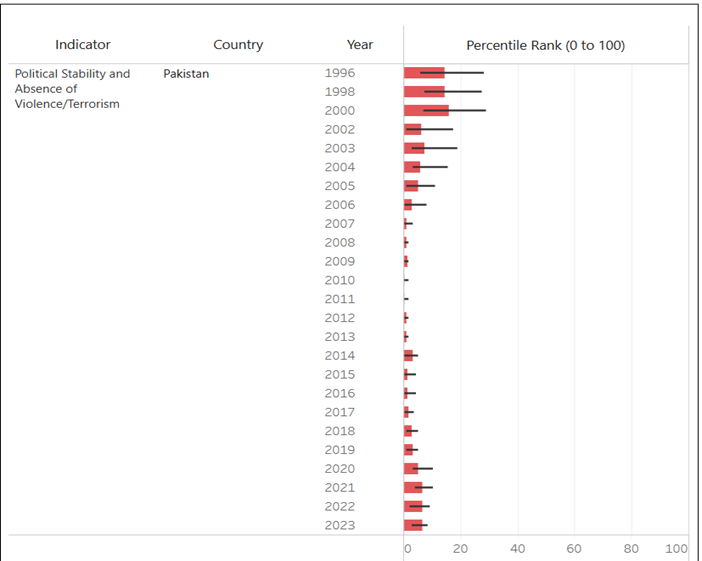
2. Political Stability and Absence of Violence/Terrorism This measures perceptions of the likelihood of political instability, violence, or terrorism affecting governance. Pakistan continues to face political instability risks stemming from frequent government changes, protests, and internal security challenges. Efforts to improve law enforcement and counter-terrorism have somewhat stabilized security environments, but political uncertainty and episodic violence remain key risks.
Source: Worldwide Governance Indicators (WGI) World Bank
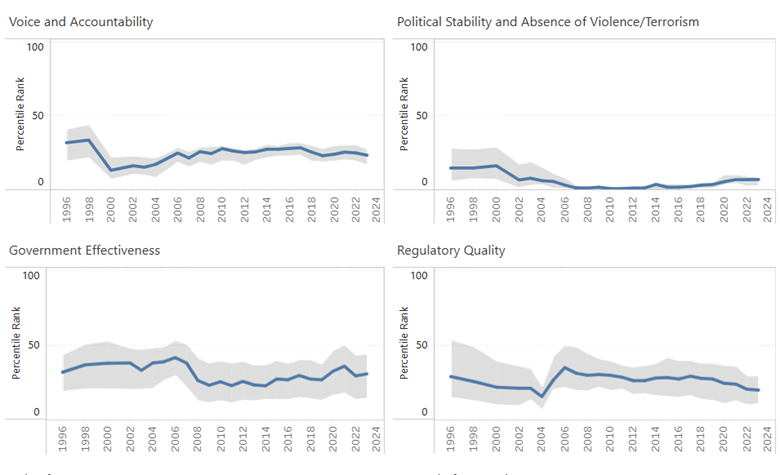
The above figure paint a sobering picture of Pakistan’s political stability. In 1996, Pakistan’s percentile rank for Political Stability and Absence of Violence stood at 14.36, inching up slightly to 15.87 in 2000. However, this modest progress was short-lived. A persistent downward trend followed, with the indicator plunging to its lowest point during 2009–2010, a period marked by heightened governance challenges. Today, Pakistan’s rank has slipped below 10, signaling an alarmingly fragile environment. This continuous erosion of political stability has far-reaching implications for investors’ confidence, discouraging growth & development, and weakening the social contract which make sustainable progress extremely difficult.
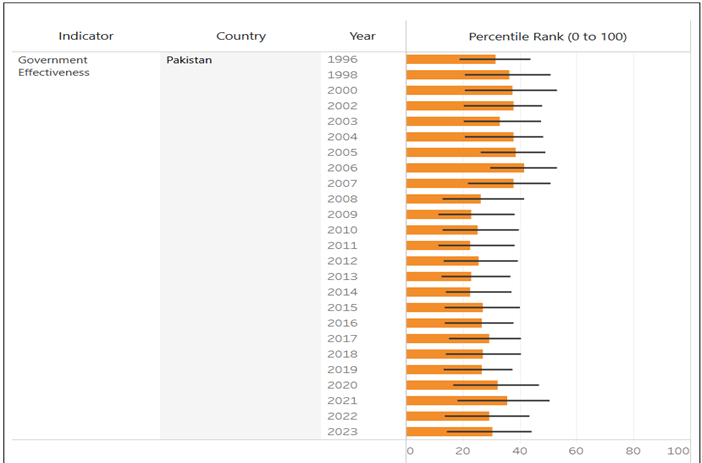
3. Government Effectiveness This key dimension evaluates the quality of public services, bureaucracy efficiency, policy formulation, and implementation. Pakistan’s government effectiveness remains below average globally, with a percentile rank near the 30th percentile as of 2023 data, indicating that 70% of countries perform better. Challenges include bureaucratic inefficiency, politicization of civil services, and weak policy continuity. However, ongoing reforms under Vision 2025 and structural reform programs aim to improve service delivery and institutional capacity.
Source: Worldwide Governance Indicators (WGI) World Bank
The above figure reveals a troubling pattern in Pakistan’s government effectiveness. Starting at a percentile rank of 31.69 in 1996, the country saw modest improvements—rising to 36.61 in 1998, 37.70 in 2000, and peaking at 41.46 in 2006. However, this progress was not sustained. A steady decline followed, reflecting growing inefficiencies, weakened public service delivery, and eroding institutional capacity. By 2021, the ranking had modestly rebounded to 35.71, yet remains far below what is needed for resilient governance. This dismally poor performance in government effectiveness underscores Pakistan’s urgent need for deep structural reforms to tackle its complex socio-economic and political challenges, enhance public trust, and ensure efficient, transparent, and citizen-responsive administration.
4. Regulatory Quality
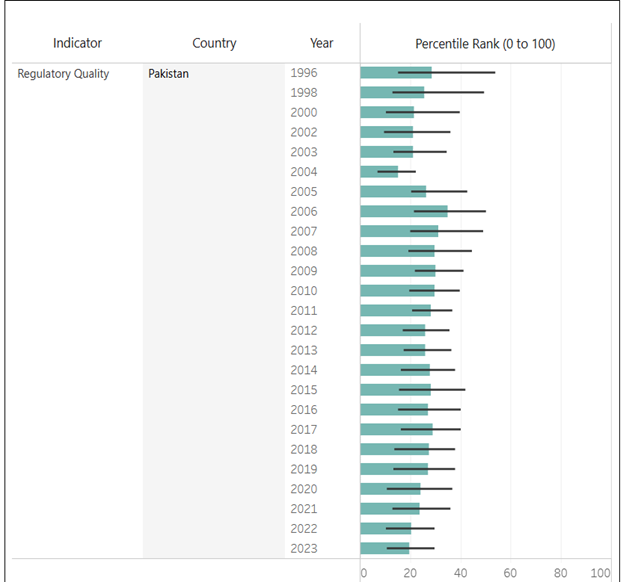
This measures the government’s ability to formulate and implement sound policies and regulations that promote private sector development. Pakistan struggles with regulatory quality due to frequent policy reversals, complex and inconsistent regulations, and challenges in ease of doing business. Recent initiatives to simplify procedures and digitize regulatory processes show promise but reform implementation remains uneven.
Source: Worldwide Governance Indicators (WGI) World Bank
The World Governance Indicators reveal a stark reality about regulatory quality in Pakistan. With a percentile rank of 28.80 in 1996, the country already lagged behind global standards, and this rank further slipped to 26.47 by 2005. A brief improvement to 34.80 in 2006 offered a glimmer of hope, but it was short-lived. Over the next two decades, regulatory quality consistently deteriorated, plunging to a dismal 19.81 by 2023. This persistent decline reflects weak enforcement of rules, policy unpredictability, and a lack of institutional autonomy. In the face of rising socioeconomic challenges, such poor regulatory performance seriously undermines investor confidence, hinders innovation, and stifles inclusive growth. Urgent reforms are critical to restore credibility, ensure fair market competition, and steer Pakistan toward sustainable development.
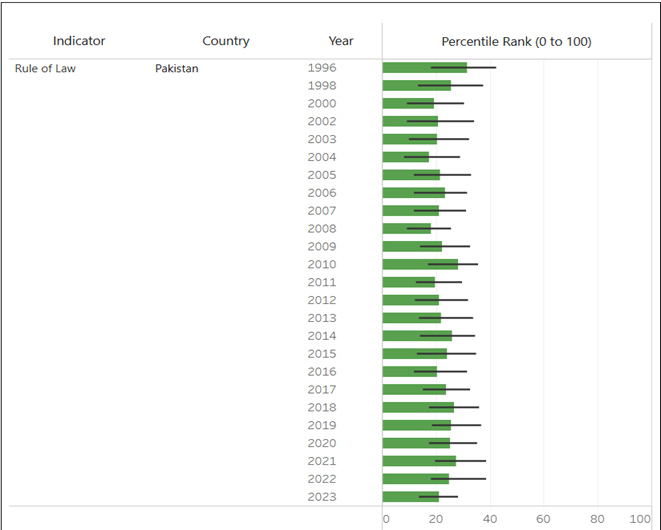
5. Rule of Law Rule of Law quantifies confidence in the judiciary, contract enforcement, property rights, police, and absence of crime. Pakistan’s scores on rule of law are generally low, pointing to systemic issues such as judicial delays, lack of independence, and law enforcement inefficiencies. Political interference in judicial matters and concerns over human rights enforcement weigh on investor confidence and social stability.
Source: Worldwide Governance Indicators (WGI) World Bank
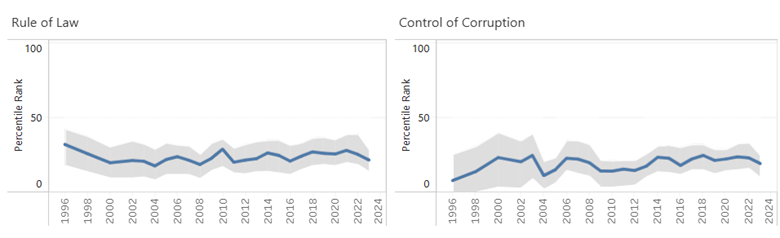
The World Governance Indicators paint a troubling picture of the rule of law in Pakistan, which has eroded steadily over the past three decades. From a percentile rank of 31.66 in 1996, it has dropped alarmingly to just 21.23 in 2023, a stark indicator of weakening legal institutions, lack of accountability, and widening justice gaps. This dismal trajectory reflects growing deprivation, marginalization, and public resentment, especially among the vulnerable. As trust in state institutions crumbles, the very fabric of social cohesion is at risk. Rebuilding the rule of law is not just a governance issue, it is a national imperative. Pakistan must urgently restore judicial credibility, ensure equal justice, and strengthen institutions to regain public trust and lay the foundation for inclusive, sustainable development.
6. Control of Corruption
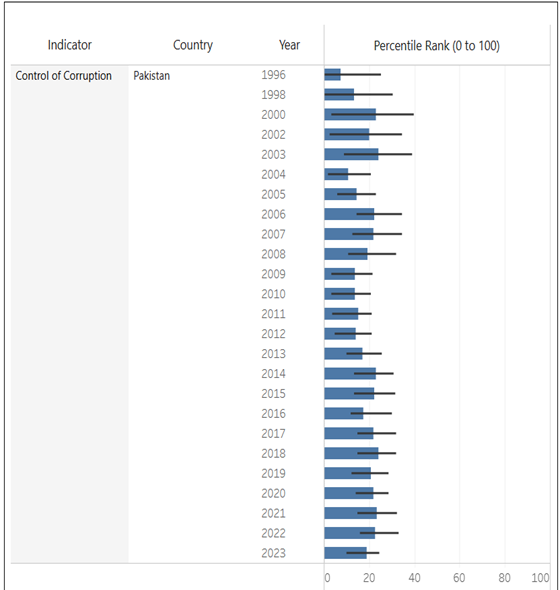
This dimension assesses perceptions of the extent to which public power is exercised for private gain. Pakistan ranks in the severely low percentiles for control of corruption, reflecting endemic corruption at various government levels. Despite some high-profile anti-corruption drives and increased transparency efforts, corrupt practices remain a major governance challenge. The government has launched initiatives to improve financial disclosures, anti-corruption hotlines, and digital asset registrations to combat this.
Source: Worldwide Governance Indicators (WGI) World Bank
Pakistan’s dismal track record on control of corruption is a glaring alarm for its governance system. According to the World Bank’s Worldwide Governance Indicators, Pakistan had a percentile rank of just 7.53 in 1996, which barely improved to 18.87 by 2023, a troubling reflection of nearly three decades of systemic failure. Despite repeated promises, successive governments have been unable or unwilling to dismantle the entrenched networks of corruption that bleed national resources and cripple public service delivery. This chronic failure erodes public trust, deters investment, and undermines the legitimacy of state institutions, leaving citizens disillusioned and the economy weakened. Tackling corruption must become a national imperative not just for integrity, but for survival and progress. Transparency International consistently ranks Pakistan among the corrupt countries in its annual Corruption Perceptions Index (CPI), highlighting systemic issues in governance, weak accountability, and lack of transparency. In recent years, Pakistan’s CPI scores have stagnated or declined, reflecting widespread public sector corruption, political interference in institutions, limited enforcement of anti-corruption laws, and lack of access to public information. Despite the existence of anti-corruption bodies like NAB, their politicization and selective accountability have undermined public trust. Procurement irregularities, non-transparent budgeting, and elite capture of resources further reinforce the perception of entrenched corruption. This ranking is a wake-up call, signaling the urgent need for institutional reforms, independent oversight, and a culture of integrity to restore faith in governance and promote sustainable development.
The Bottom Line
Pakistan’s governance environment as per the WGI places it generally below the global median across major indicators, with particular weaknesses in political stability, rule of law, government effectiveness, and corruption control. The country is in the bottom 13th percentile for corruption control and near the 30th percentile for government effectiveness, indicating room for significant improvement. These governance deficits directly constrain economic growth through reduced investor confidence, policy uncertainty, and inefficiency. Ongoing reform commitments under Pakistan’s Vision 2025 include goals to improve these governance dimensions, with measured progress seen in fiscal management, service delivery, and some regulatory overhauls. Stabilizing political environment, enhancing judicial independence, strengthening institutions, and aggressively combating corruption are critical to enhancing Pakistan’s governance scores and unlocking better development outcomes.
Sources:
World Bank We are deeply thankful to World Bank for the generating & Publishing WGI for public use to get new insights about the overall governance performance of a country.